

There is a special frustration in being told that everything is normal.
At first, it sounds like good news.
The ultrasound is normal.
Periods are regular.
Semen analysis is okay.
Hormone reports are acceptable.
Maybe even the tubes look open.
The doctor smiles and says, “Everything seems fine. Keep trying.”
So the couple tries.
One month. Three months. Six months. A year.
The reports remain normal.
The pregnancy test does not.
That is when “normal” stops feeling comforting and starts feeling like a locked room.
What unexplained infertility actually means
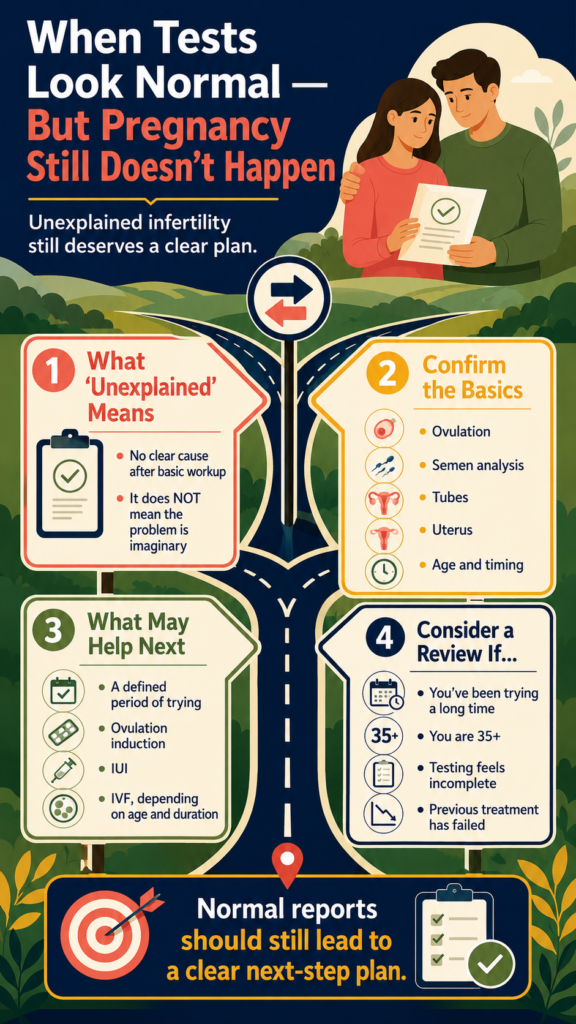
Unexplained infertility does not mean nothing is wrong. It means no clear cause has been found after standard fertility evaluation.
WHO notes that infertility may occur due to male, female or unexplained factors, and sometimes it is not possible to explain the causes.
ASRM’s ReproductiveFacts guidance says that in 10 percent or more of cases, there may not be an obvious reason why a couple cannot conceive, and this is known as unexplained infertility. It also notes that fertility treatments can still help couples with unexplained infertility.
This distinction matters.
Unexplained does not mean hopeless.
It means the usual tests have not revealed the answer.
It may also mean that the cause is too subtle to show up on basic fertility tests. We may need to look deeper, assess the possible reasons, and determine whether there is an underlying issue or whether this is simply a case of bad luck.
The hidden grief of “everything is normal”
When a report is abnormal, at least the couple has something to point to.
Blocked tube. Low sperm count. PCOS. Low AMH. Fibroid. Thyroid issue.
There is fear, yes. But there is also direction.
Unexplained infertility is different. It is mist with paperwork.
Couples may begin to doubt themselves. Are we timing it wrong? Is stress doing this? Is there something the doctor missed? Should we try harder? Should we stop thinking about it? Should we start IVF? Should we get another opinion?
In Delhi NCR, where many couples are balancing demanding jobs, traffic, family expectations and private anxiety, unexplained infertility can become mentally exhausting. Every normal report should bring relief, but instead it can deepen the mystery.
Unexplained infertility can be a deeply frustrating diagnosis because no test or doctor can point to one clear problem. At the same time, it can also leave room for hope. When the fallopian tubes are blocked or semen parameters are very low, the cause may be clear, but the treatment path often leads towards IVF.
With unexplained infertility, especially when a couple has not been trying regularly for a long time, a deeper evaluation may be helpful. In some cases, there may be a subtle issue that routine tests have missed. In others, the couple may simply have been unlucky so far and could still conceive naturally in the coming months.
What must be checked before calling it unexplained?
Before a couple accepts the label “unexplained,” it is worth asking whether the basic fertility workup was complete.
At a minimum, the doctor usually needs to understand:
Is ovulation happening?
Is sperm count, motility and morphology acceptable?
Are the fallopian tubes open?
Does the uterus look suitable for implantation?
Is age affecting egg quality?
Are there symptoms of endometriosis, thyroid disease, PCOS or other conditions?
The CDC notes that initial fertility evaluation may include semen analysis, tubal evaluation and ovarian reserve testing depending on the couple’s circumstances.
A more detailed evaluation can sometimes reveal subtle issues that routine fertility tests may miss. A follicular study may identify mild ovulation problems. A thorough semen analysis from a reliable andrology laboratory may detect minor abnormalities that were previously reported as normal. Tubal testing may show slight dilation, while a clinical assessment may raise the possibility of mild endometriosis. Blood tests such as AMH may also reveal a lower-than-expected egg reserve.
Once these factors are identified, the diagnosis may shift from “unexplained infertility” to a clearer, more specific cause. Treatment can then be directed towards those particular issues.
When these areas have not been properly evaluated, the infertility may not truly be unexplained. It may simply be under-investigated.
Regular periods do not prove everything
This is a common trap.
A woman with regular periods may assume ovulation is fine. Often, that may be true. But regular bleeding does not tell the full story of egg quality, tubal function, sperm function or implantation.
Similarly, a normal semen analysis is reassuring, but it does not test every possible sperm function issue. A normal ultrasound does not always rule out mild endometriosis. An open tube test does not describe every subtle function of the fallopian tube.
Fertility is a chain of events. Standard tests check many strong links, but not every microscopic turn.
This is why unexplained infertility can feel so unfair.
Everything obvious may look fine, yet pregnancy still does not happen.
Possible reasons pregnancy may not happen despite normal reports
A doctor may discuss several possibilities.
The egg may not be released at the ideal time. Sperm may not meet the egg. Fertilisation may not occur. The embryo may not develop normally. The tube may not move the embryo efficiently. Implantation may not happen. Mild endometriosis may be present without obvious scan findings. Egg quality may be lower due to age, even when cycles are regular.
These are not diagnoses. They are possibilities.
And that is exactly why the next step should be structured, not random.
Why “just keep trying” may or may not be right
For some couples, continued trying is reasonable. A younger couple trying for a shorter time, with a complete and reassuring evaluation, may be advised to keep trying naturally for a defined period.
But indefinite trying is different.
ASRM says couples should generally see a reproductive endocrinologist if they have not conceived within 12 months of trying, or after 6 months after age 35.
Age matters. Duration matters. Previous treatment attempts matter. Emotional exhaustion matters too.
A couple who has been trying for two years should not be given the same advice as a couple trying for four months.
Time is a medical factor.
Treatment options: not one road for everyone
Unexplained infertility may be approached in different ways.
Some couples may continue timed intercourse for a defined period.
Some may be advised ovulation induction with timed intercourse, especially if ovulation timing is uncertain.
Some may consider IUI if tubes are open and semen parameters are suitable.
Some may consider IVF, especially when age is higher, duration is long, previous simpler treatments have failed or the couple wants more information about fertilisation and embryo development.
The CDC lists timed intercourse, medications, intrauterine insemination, surgery and assisted reproductive technology among infertility treatment options, depending on cause, duration, age and couple preferences after counselling.
The key phrase is depending on.
There should be a reason for each step.
Beware of the add-on jungle
When couples are desperate for answers, they become vulnerable to unnecessary tests, add-ons and expensive promises.
NICE’s fertility guidance emphasises clear information, shared decision-making and avoiding add-on treatments that do not have strong evidence.
This is especially important in unexplained infertility.
When nobody can name the exact cause, couples may be offered everything. More injections. More tests. More procedures. More “advanced” options.
But advanced does not always mean appropriate.
A good doctor should be able to say, “This may help because…” or “This is not needed right now because…”
Clarity protects couples from both delay and overtreatment.
What to bring for a second opinion
If you are seeking a review for unexplained infertility, bring:
All blood tests.
Ultrasound reports.
Semen analysis reports.
HSG or tubal test reports.
Treatment prescriptions.
Follicle monitoring sheets.
IUI or IVF records, if any.
A timeline of how long you have been trying.
Dates of miscarriages or biochemical pregnancies, if any.
The timeline is often as important as the tests. A fertility specialist needs to know not only what was checked, but when, why and what happened after.
A clear next step in Delhi NCR/Noida
For couples in Delhi NCR, an unexplained infertility clarity consultation at Zeeva Fertility can help review whether the workup was complete, whether anything was missed and what the next step should be.
The goal is not to turn every unexplained case into IVF.
The goal is to stop wandering.
Because “normal reports” should not leave a couple feeling abandoned.
Sometimes the answer is not one dramatic discovery. Sometimes it is a better map.
FAQs
Is unexplained infertility common?
Yes. ASRM notes that in 10 percent or more of infertility cases, no obvious reason may be found.
Can unexplained infertility resolve naturally?
Sometimes pregnancy can happen without treatment, especially in younger couples and shorter-duration cases. But age and duration of trying matter.
Does unexplained infertility mean IVF is required?
No. Options may include continued trying, ovulation induction, IUI or IVF depending on the couple’s situation.
What tests should be done before calling it unexplained?
Ovulation assessment, semen analysis, tubal evaluation and uterine/ovarian review are usually important parts of the workup.
Should we get a second opinion?
A second opinion can be useful if you have been trying for a long time, have incomplete testing or have been advised treatment without a clear explanation.








0 Comments
Join the conversation