

The word IVF has become so large that it often swallows the whole fertility conversation.
A couple struggles to conceive. Someone says IVF.
A woman has PCOS. Someone says IVF.
A semen report is mildly abnormal. Someone says IVF.
A couple visits a clinic for the first time and quietly fears they will be handed a package before anyone understands their story.
But fertility treatment is not one staircase with IVF at the top and everyone pushed upward.
It is more like a set of doors.
The right door depends on what is actually stopping pregnancy.
Fertility treatment should start with the problem
The CDC describes pregnancy as a process with several steps: egg release, fertilisation by sperm, travel through the fallopian tube and implantation in the uterus. A problem with any one or several of these steps can contribute to infertility.
That means the first job of a fertility doctor is not to sell a treatment.
The first job is to locate the bottleneck.
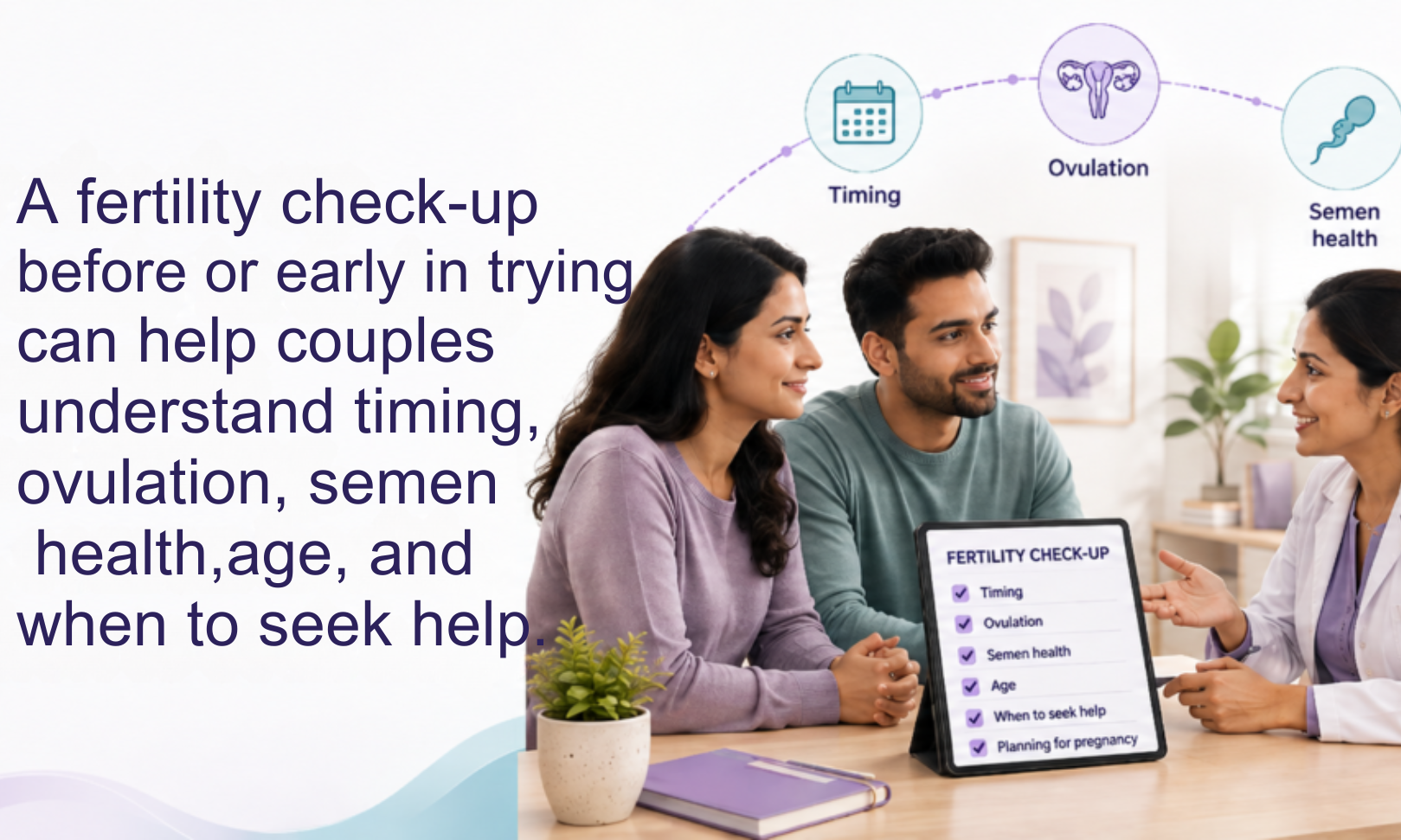
Is ovulation irregular? Is sperm count or movement low? Are the tubes blocked? Is age affecting egg quality? Is the uterus distorted by fibroids? Has there been recurrent miscarriage? Has treatment already failed elsewhere?
A treatment should answer a problem.
If nobody can explain what problem IVF is solving in your case, pause and ask.
The main treatment paths
The NHS describes three broad types of fertility treatment: medicines, surgical procedures and assisted conception, including IUI and IVF.
That is a useful way to think about it.
Not every couple needs assisted reproduction immediately. Some need ovulation medicines. Some need surgery for a specific reason. Some need IUI. Some need IVF. Some need ICSI. Some need more testing before any treatment.
The menu should not be confused with the meal.
When ovulation induction may be enough
Ovulation induction means using medicines to help a woman release an egg. This may be considered when ovulation is irregular or absent, such as in some women with PCOS.
The NHS notes that medicines such as clomifene can encourage monthly egg release in women who do not ovulate regularly or cannot ovulate at all, and metformin may be beneficial for women with PCOS.
In real life, this may look like tablets, follicle monitoring, a trigger injection in some cases and timed intercourse.
This may be appropriate if the woman is younger, the tubes are open, semen analysis is normal or close to normal and there are no other major factors.
But ovulation induction is not magic. If the tubes are blocked or sperm is severely abnormal, making more eggs available may not solve the problem.
That is why testing matters before repeating cycles.
When IUI may make sense
IUI, or intrauterine insemination, involves placing prepared sperm directly into the uterus around ovulation. The NHS explains that sperm is collected, washed and the best-quality, fastest-moving sperm are selected before being inserted into the womb through a thin tube.
The CDC says IUI may be recommended when sperm count and motility are close to normal, the woman has open functioning tubes, and in cases such as ovulation problems, unexplained infertility or mild male factor infertility.
This is why IUI needs prerequisites.
At least one tube should be open. Sperm parameters should be suitable. Ovulation should be timed. Age and duration of infertility should be considered.
IUI is not “mini IVF.” It does not fertilise the egg outside the body. It simply improves timing and sperm placement.
For the right couple, it may be a sensible step. For the wrong couple, repeated IUI can become a costly calendar of disappointment.
When IVF may be the better step
IVF, or in vitro fertilisation, means eggs are collected from the ovaries and fertilised with sperm in a laboratory. The resulting embryo is then transferred into the uterus. The NHS describes IVF as fertilisation outside the body after medicines encourage the ovaries to produce more eggs.
IVF may be discussed earlier when the fallopian tubes are blocked, sperm factor is significant, the woman’s age is higher, ovarian reserve is low, endometriosis is advanced, previous simpler treatments have failed, or time is medically important.
IVF may also provide information that timed intercourse and IUI cannot: how many eggs are retrieved, whether fertilisation happens, how embryos develop.
But IVF is still a treatment, not a personality test.
Needing IVF does not mean a couple failed.
Not needing IVF yet does not mean the couple is careless.
The right question is: Does IVF fit this case now?
ICSI: when sperm needs extra help
ICSI, or intracytoplasmic sperm injection, is often used when male factor infertility is significant. The CDC explains that with ICSI, a single sperm is injected into a mature egg.
This may be discussed when sperm count or motility is very low, or when previous fertilisation has been poor. It is usually part of an IVF cycle.
Again, the reason matters.
The danger of repeating treatment without review
Many couples in Delhi NCR come for a second opinion after several cycles elsewhere.
Three ovulation cycles. Four IUIs. One failed IVF. Sometimes no one has clearly explained what changed after each attempt.
A good fertility plan should have review points.
If ovulation induction fails, ask why and what was confirmed.
If IUI fails, ask whether tubes, sperm, age and duration still support more IUIs.
If IVF fails, ask what happened at each stage: stimulation, egg retrieval, fertilisation, embryo development, transfer and luteal support.
NICE’s fertility guidance emphasises clear information, shared decision-making and avoiding add-on treatments that do not have strong evidence.
That principle matters everywhere, including private fertility care in India.
Couples deserve explanations, not just next invoices.
Questions to ask before starting treatment
Ask your doctor:
What diagnosis are we treating?
Are my tubes open?
Is the semen analysis suitable for this option?
Am I ovulating?
How does my age affect this plan?
How many cycles should we try before reviewing?
What are realistic success chances in our case?
What are the costs, risks and alternatives?
If this fails, what will we learn?
These questions do not make you difficult. They make you informed.
A treatment roadmap consultation in Noida
For couples in Noida and Delhi NCR, a treatment roadmap consultation at Zeeva Fertility can help decide whether the next step should be timed intercourse, ovulation induction, IUI, IVF, ICSI or further testing.
The goal is not to avoid IVF when IVF is needed.
The goal is to avoid IVF when it is not.
And to avoid delay when IVF is the smarter path.
Fertility treatment should not feel like being pushed down a corridor.
It should feel like someone finally turned on the lights and showed you the doors.
FAQs
Is IVF always the best fertility treatment?
No. The best treatment depends on age, ovulation, sperm, tubes, uterus, duration of infertility and previous treatment.
When is IUI useful?
IUI may help in selected cases such as ovulation problems, unexplained infertility or mild male factor, when tubes are open and sperm is suitable.
Does PCOS always need IVF?
No. Some women with PCOS may start with lifestyle changes, ovulation induction and monitoring, depending on the case.
How many IUIs should we try?
This depends on age, diagnosis, semen parameters and previous cycles. Repeated attempts without review are not ideal.
What should I ask before IVF?
Ask why IVF is advised, what problem it solves, expected chances, cost, risks, alternatives and what will be reviewed if it fails.






0 Comments
Join the conversation