
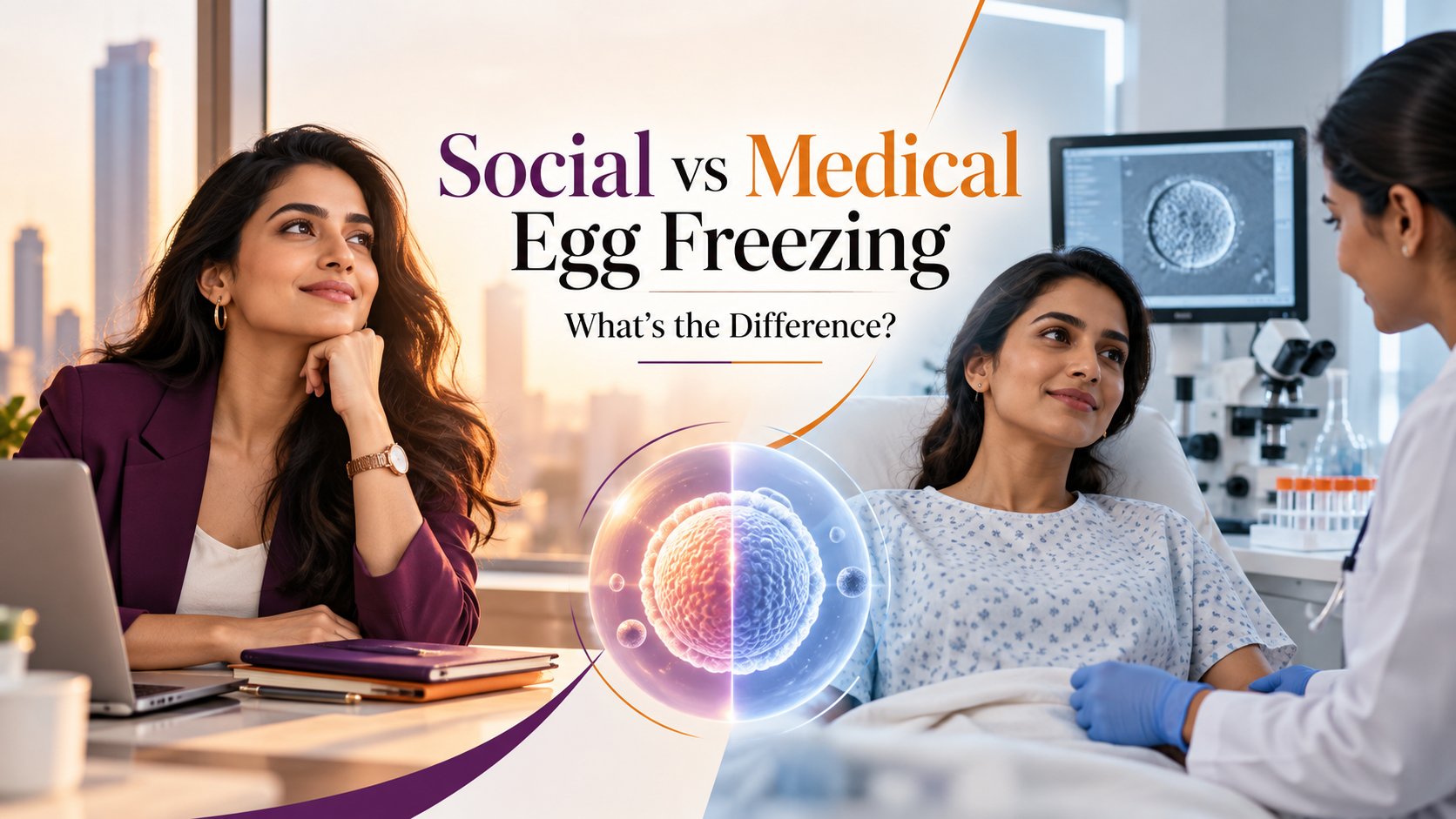
Egg freezing, or mature oocyte cryopreservation, can be used for different reasons. The laboratory steps are broadly similar whether someone freezes eggs for personal timing reasons or because a medical condition may threaten fertility. The difference lies mainly in the reason, urgency, counselling and sometimes how treatment is coordinated.
What is social egg freezing?
“Social” or elective egg freezing usually refers to freezing eggs because pregnancy is being postponed for non-medical reasons. A person may be focused on education or career, may not have the right partner, may not be ready for parenthood, or may simply want additional reproductive options for the future.
The term does not mean the decision is casual. It still involves medication, monitoring, egg retrieval, storage costs and uncertainty about future use.
What is medical egg freezing?
Medical egg freezing is considered when a disease or treatment may reduce fertility. Examples can include chemotherapy, pelvic radiation, certain ovarian surgeries, some genetic or autoimmune conditions, or other circumstances in which ovarian function may be at risk.
Timing can be more urgent because fertility preservation may need to happen before treatment begins.
Is the procedure different?
The core process is similar: ovarian-reserve assessment, stimulation injections, monitoring, egg retrieval and vitrification of mature eggs. Medical cases may use modified protocols depending on the diagnosis and treatment timeline.
Why age at freezing matters
Egg freezing preserves eggs at the age at which they are collected. Younger eggs generally have a lower rate of chromosome abnormalities than eggs collected later. This is why age is often more informative than AMH when discussing egg quality.
AMH and antral follicle count are useful for estimating expected response to stimulation, but they do not guarantee natural fertility or predict the quality of each egg.
How many eggs are enough?
There is no universal number. The number of mature eggs needed for a reasonable chance of future live birth depends strongly on age at freezing and individual factors. Some people may need more than one stimulation cycle to bank the number they want.
What happens when frozen eggs are used?
Eggs are thawed, and surviving mature eggs are generally fertilised using ICSI. The resulting embryos are cultured and assessed, and an embryo may later be transferred to the uterus. Not every egg survives thawing, fertilises, forms a blastocyst or leads to pregnancy.
Emotional and financial considerations
Elective egg freezing can provide reproductive options but may also create a false sense of security if counselling is poor. Medical egg freezing can happen during an already stressful diagnosis. In both cases, transparent counselling about success rates, costs, storage and future use is essential.
When should you discuss egg freezing?
If you expect to delay pregnancy into the later 30s, have a family history of early menopause, face ovarian surgery, or are about to start treatment that may affect fertility, consider discussing preservation before the situation becomes urgent.
Key takeaway
Social and medical egg freezing use similar technology but serve different needs. Neither guarantees a future baby. The best decision combines age, ovarian reserve, health, timing, cost and personal reproductive goals.
Medical disclaimer: This article is educational and should not replace personalised fertility-preservation advice.
Practical questions to discuss at your appointment
Before making a treatment decision, ask what the diagnosis is based on, whether any test should be repeated, and how the result changes management. Ask what happens if you choose to wait, whether a simpler option is reasonable, and which outcomes the clinic uses when discussing success. If a treatment involves medication, surgery or an assisted reproductive procedure, understand the expected benefits, common side effects, alternatives and the point at which the plan would be reviewed.
For social egg freezing vs medical egg freezing, it is also useful to separate tests that are essential from optional “add-ons”. More testing is not always better. A test is most valuable when the result is likely to change what you and your doctor do next. The same principle applies to supplements and laboratory technologies: use them for a clear indication rather than because they sound advanced.
If pregnancy is the goal, evaluate both partners where relevant and consider age early in the decision. Fertility is time-sensitive, but that does not mean every patient needs IVF immediately. Good care balances timely action with avoiding unnecessary intervention.
Everyday planning
Keep a simple record of menstrual dates, major symptoms, relevant test reports, current medicines and previous fertility treatment. Bring these to your consultation. This can reduce repeated testing and helps the clinician see trends rather than isolated results. If you are using supplements, herbal products, hormones or gym medications, include them on the list because they can affect reproductive health or interact with treatment.
Reliable fertility information should make decisions clearer, not more frightening. Be cautious with claims that a single food, device, supplement or procedure can “guarantee” conception. For most fertility conditions, the best plan is a sequence: identify the main problem, choose the least invasive reasonable treatment, review the response and escalate only when there is a clinical reason.







0 Comments
Join the conversation