
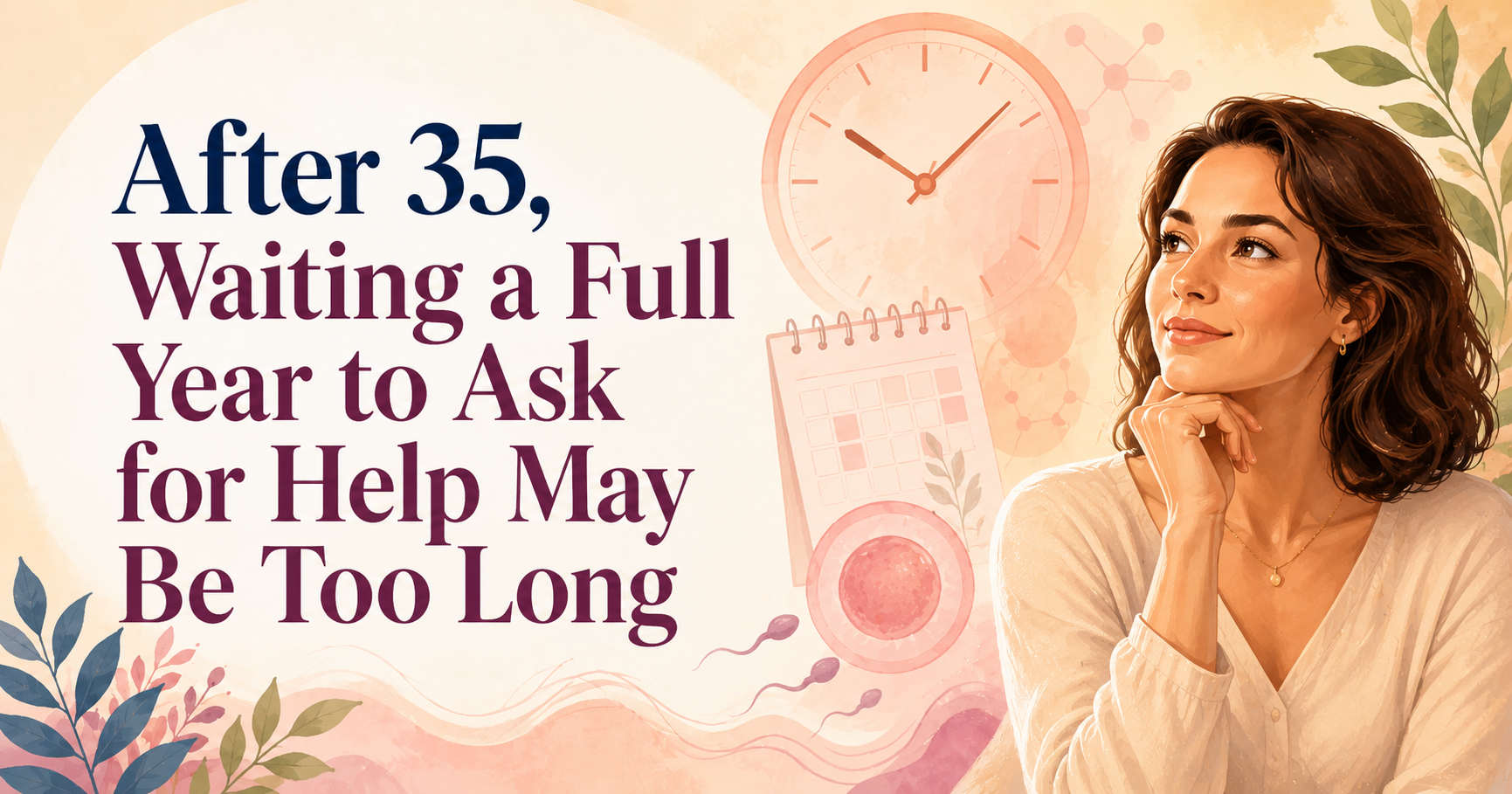
She does not feel old.
That is the first thing to understand.
She may be 35, 36, 38 or 40. She may be doing well at work. She may have married later, by choice or by life’s timing. She may finally feel emotionally ready for a baby.
She may be trying for a second pregnancy and feels it will happen as easily as the first one
Then fertility enters the room carrying a stopwatch.
Suddenly everyone has an opinion.
“Don’t delay.”
“You should have planned earlier.”
“Try naturally for a year.”
“Go straight to IVF.”
“Your AMH must be checked immediately.”
For many women in Delhi NCR, turning 35 does not feel like a birthday. It feels like a deadline.
But fertility after 35 needs neither panic nor denial.
It needs clear timing.
Why 35 matters, but not like a switch
Your body does not wake up on your 35th birthday and declare a new policy.
Fertility decline is gradual. But age does matter because egg number and egg quality reduce over time. ASRM’s ReproductiveFacts explains that age can have a big effect on the ability to have a baby, especially as egg quality and number decline in the 30s and 40s. It also notes that for a healthy person in their 20s or early 30s, the chance of conceiving each month is around 25 to 30 percent, while at age 40 it is 10 percent or less.
That is why 35 is treated as an important medical marker.
Not because pregnancy becomes impossible.
Not because every woman needs IVF.
But because time becomes more valuable.
A 29-year-old and a 38-year-old may both be trying for six months. Emotionally, both may feel the same disappointment. Medically, their timelines may need to be different.
The “try for one year” rule has an age exception
Many couples hear that infertility means trying for one year without pregnancy. That is broadly true for younger couples with no obvious fertility concerns.
But there is an important exception.
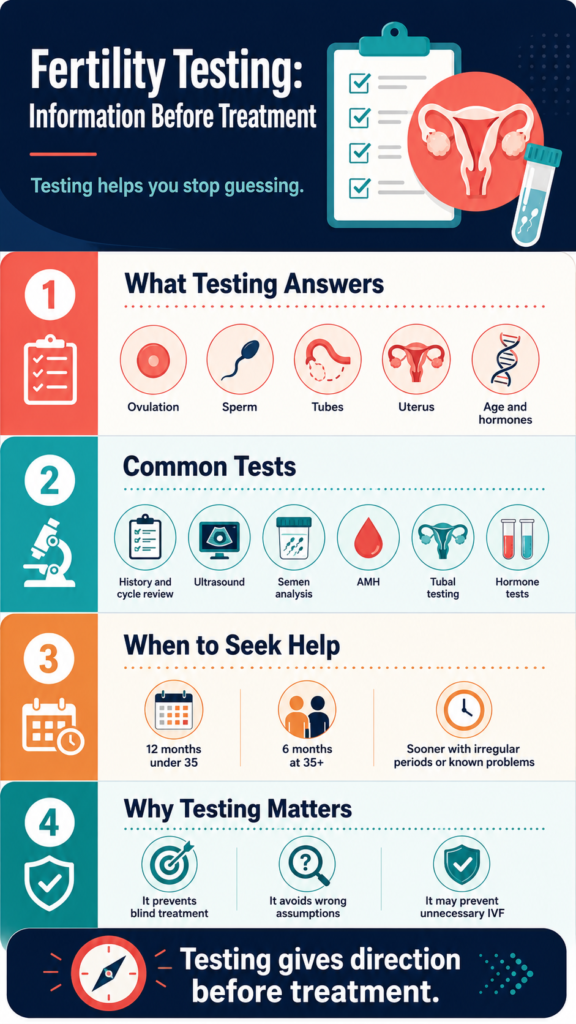
ASRM’s ReproductiveFacts guidance says heterosexual couples should seek help after 12 months of regular unprotected sex if the person with ovaries is under 35, and after 6 months if the person with ovaries is 35 or older.
The CDC gives similar guidance: couples where the woman is under 35 and has regular cycles can try for at least one year before seeing a provider, while couples where the woman is 35 or older should see a provider after 6 months of unsuccessful trying. Couples where the woman is older than 40 should consider more immediate evaluation.
This is not meant to scare you.
It is meant to protect your options.
What actually changes after 35?
The most important change is egg quality.
Women are born with their lifetime supply of eggs. Over time, both the number and quality of eggs decline. Lower egg quality can make conception harder and can increase the chance of miscarriage.
Ovarian reserve also becomes more relevant. Tests such as AMH and antral follicle count may help estimate how the ovaries might respond to fertility medicines, but they do not predict everything.
This is where many women get trapped by one number.
An AMH report arrives on WhatsApp. The value is lower than expected. Panic begins.
But AMH is not a crystal ball.
A woman with low AMH may still ovulate. A woman with normal AMH may still have age-related egg quality issues. A fertility plan after 35 should include AMH, but not worship it.
The full picture includes age, cycle regularity, ultrasound, duration of trying, semen analysis, tubal status, medical history, previous pregnancies, miscarriages and treatment history.
The husband’s test still matters
When a woman is over 35, many conversations immediately focus on her eggs. That may be medically relevant, but it should not erase the male partner.
Sperm count, movement and shape matter at every age. ASRM notes that sperm-related problems account for one-third of infertility cases, and combined issues in both partners account for another third.
If the woman is 36 and the couple spends six months only tracking ovulation, without a semen analysis, that may be wasted time.
A basic semen analysis is usually simpler, faster and less invasive than many female fertility tests. It should not be saved for the end like a reluctant footnote.
Why “just try naturally” can be incomplete advice
Trying naturally is not wrong. Many women over 35 conceive naturally.
The problem is not trying.
The problem is trying blindly for too long.
A couple may be timing intercourse correctly, but the fallopian tubes may be blocked. A woman may be having regular periods, but egg quality may be lower than expected. A husband may feel healthy, but sperm motility may be low. A woman may have fibroids, endometriosis or thyroid issues.
After 35, six months of unsuccessful trying is enough reason to ask better questions.
That does not mean treatment must begin immediately. Evaluation and treatment are not the same thing.
A consultation may simply show that everything looks reassuring and timed trying can continue for a little while. Or it may show that IUI, IVF or another step should be considered sooner.
Either way, the couple moves from guessing to knowing.
What should be checked after 35?
A fertility evaluation after 35 often includes:
A careful medical and menstrual history.
Ultrasound to assess uterus, ovaries and follicle activity.
Ovarian reserve testing such as AMH and antral follicle count, if appropriate.
Hormonal tests, depending on cycle pattern and symptoms.
Semen analysis for the male partner.
Tubal evaluation when indicated.
Review of thyroid, diabetes, weight, medications, surgeries and miscarriage history.
The CDC notes that initial evaluation may include semen analysis, tubal evaluation and ovarian reserve testing depending on the couple’s situation.
The purpose is not to create a scary file. It is to create a sensible plan.
The Delhi NCR reality: late marriages, busy careers, quiet pressure
In Noida, Gurugram, Delhi and the wider NCR, many couples are starting families later. Careers take time. Marriage may happen later. Financial stability matters. Some couples spend years caring for parents, relocating, building businesses or simply finding the right partner.
There is no moral failure in delayed parenthood.
But biology and life planning do not always move at the same speed. That is why fertility awareness is important. It gives a woman more agency, not less.
After 35, the question is not, “Did I wait too long?”
The better question is, “What is true about my fertility now, and what choices do I still have?”
When to seek help sooner than six months
Do not wait six months if there are known concerns.
Seek earlier help if you have irregular periods, no periods, known PCOS, endometriosis, previous pelvic infection, fibroids affecting the uterine cavity, previous ovarian surgery, low AMH, repeated miscarriages or a male partner with known semen issues.
The CDC also says couples should not delay seeing a provider when there are signs such as irregular or absent periods, endometriosis, pelvic inflammatory disease, uterine or tubal disease, more than one miscarriage or male sexual dysfunction.
Again, early help does not equal immediate IVF.
It means the clock is being respected.
A calmer next step
For women and couples in Delhi NCR, an age-and-fertility consultation at Zeeva Fertility can help answer the questions that Google cannot answer personally:
Are we okay to keep trying naturally?
Should we do basic testing now?
Is IUI reasonable?
Should IVF be discussed?
Do we need to act quickly because of age, AMH, sperm or tubes?
After 35, waiting a full year may be too long.
But panic is not a plan either.
Clarity is.
FAQs
Can I get pregnant naturally after 35?
Yes, many women do. But if pregnancy has not happened after 6 months of trying, evaluation is recommended.
Does turning 35 mean I need IVF?
No. Age affects fertility, but IVF is not automatic. The decision depends on your full evaluation.
Should I check AMH after 35?
AMH may be useful, but it should be interpreted with age, ultrasound and other fertility factors.
Should my husband be tested too?
Yes. Semen analysis is an important part of the fertility workup.
What if I am over 40?
The CDC recommends considering more immediate evaluation and treatment if the woman is older than 40.


0 Comments
Join the conversation