
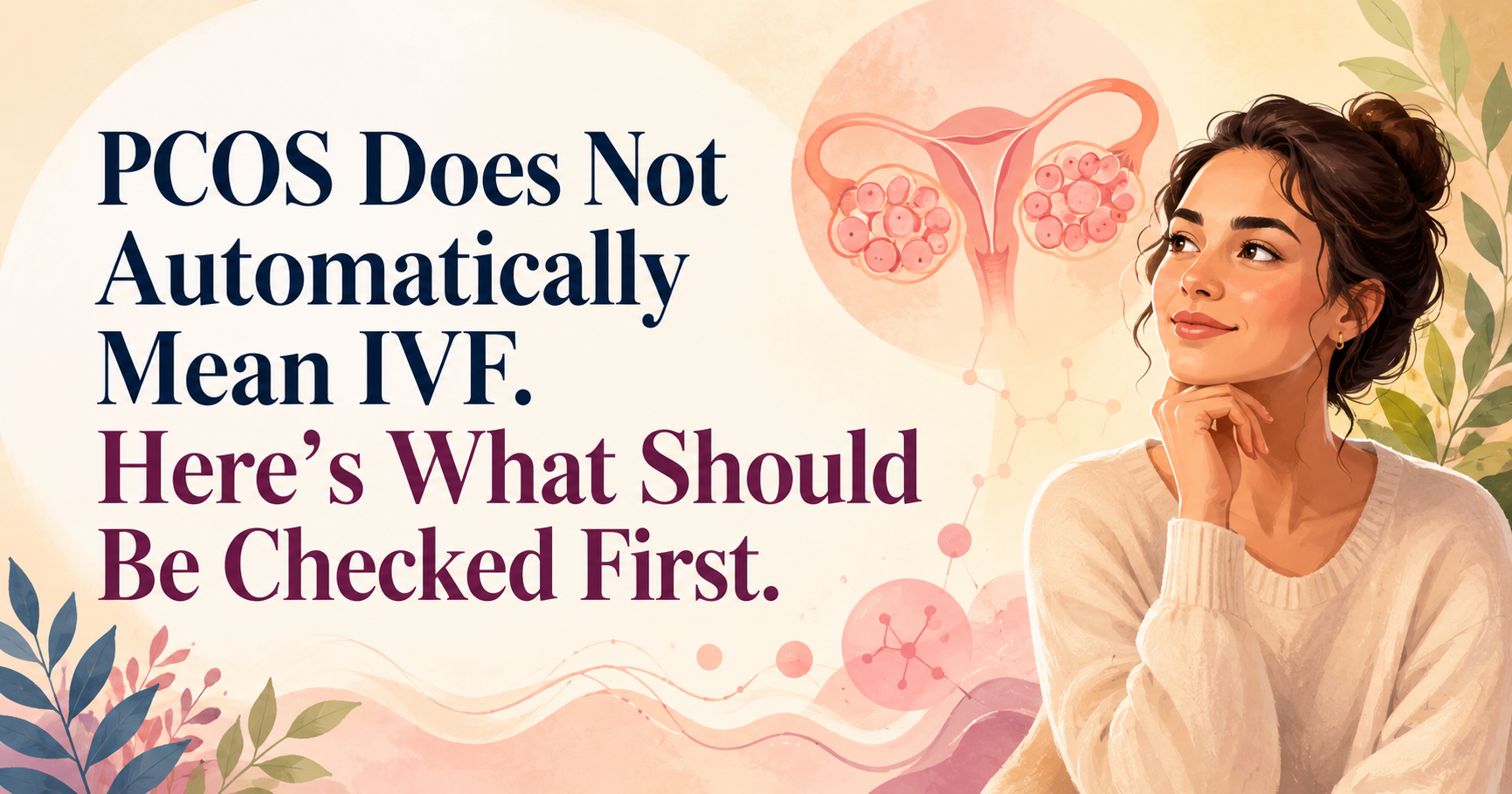
There is a particular kind of fear that arrives with four letters: PCOS.
A woman may hear it casually during an ultrasound. She may see it written on a report after months of irregular periods. Or she may already know she has PCOD/PCOS and suddenly, after marriage, the word takes on a new weight.
Earlier, it meant missed periods, acne, weight changes or facial hair.
Now it means one frightening question:
“Will I be able to get pregnant?”
For many women in Noida and Delhi NCR, this fear becomes sharper because fertility advice comes from everywhere. A relative says, “Lose weight first.” A friend says, “Just start IVF, don’t waste time.” An Instagram doctor says one thing. A clinic package says another.
But here is the gentler truth: PCOS does not automatically mean IVF.
It means your fertility picture needs to be understood properly.
[Important: Doctors are changing the name PCOS to PMOS (Polyendocrine Metabolic Ovarian Syndrome). The old name is misleading because many women with the condition do not actually have ovarian cysts. The new name, PMOS, helps doctors treat it as a whole-body health issue. It highlights how the condition affects multiple hormones (Polyendocrine), body metabolism (Metabolic), and reproductive health (Ovarian Syndrome). This change helps women get faster, better full-body care.]
PCOS is common, but it is not the same in every woman
Polycystic ovary syndrome, or PCOS, is a hormonal and metabolic condition. The World Health Organization describes PCOS as a common hormonal disorder in which higher-than-normal androgen levels can lead to irregular periods, abnormal ovulation, infertility, excess hair growth and acne. WHO estimates that PCOS affects about 10 to 13 percent of reproductive-aged women, and many women with PCOS remain undiagnosed.
That last part matters.
Many women do not discover PCOS in their teenage years. They discover it when pregnancy does not happen.
One woman has a cycle every 45 days. Another has no period for three months. Another bleeds regularly but may not ovulate consistently. One woman gains weight around the belly. Another is thin and still has PCOS. Some have acne and hair growth. Some have almost no visible symptoms.
This is why a good fertility plan for PCOS cannot be copied from another woman’s treatment file. PCOS is not one locked door. It is a hallway with many doors, and the right one must be found. Its a spectrum with some having mild symptoms or none other than subfertility with others having all the symptoms.
The real question is not “Do I have PCOS?”
The better question is:
“Is PCOS stopping ovulation, and is anything else also affecting pregnancy?”
Pregnancy is not only about the ovaries. For pregnancy to happen naturally, several things need to line up. An egg should be released. Sperm should reach the egg. The fallopian tubes should be open. The uterus should be receptive. The timing should be close enough for fertilisation to happen.
PCOS often affects the first part: ovulation.
Ovulation is the release of an egg from the ovary. In women with PCOS, ovulation may happen late, unpredictably or not at all in some cycles. That is why irregular periods are such an important clue. WHO lists irregular or absent periods and difficulty conceiving among possible symptoms of PCOS.
But here is where many couples lose time: they assume PCOS is the only issue.
A woman may take ovulation medicines for months, but the husband’s semen analysis is never done. Or the couple may keep trying naturally, but the fallopian tubes have never been checked. Or the woman may be told to lose weight without anyone checking thyroid, prolactin, sugar levels or insulin resistance.
PCOS may be part of the story. It may not be the whole book.
Why IVF may not be the first step
For many women with PCOS, the first medical goal is not IVF. It is to understand and support ovulation.
WHO notes that PCOS-related infertility may be treated with lifestyle changes, medicines or surgery to stimulate ovulation; IVF and other assisted reproductive technologies may also be used when appropriate.
Read that carefully.
IVF is one possible option, not the automatic first option.
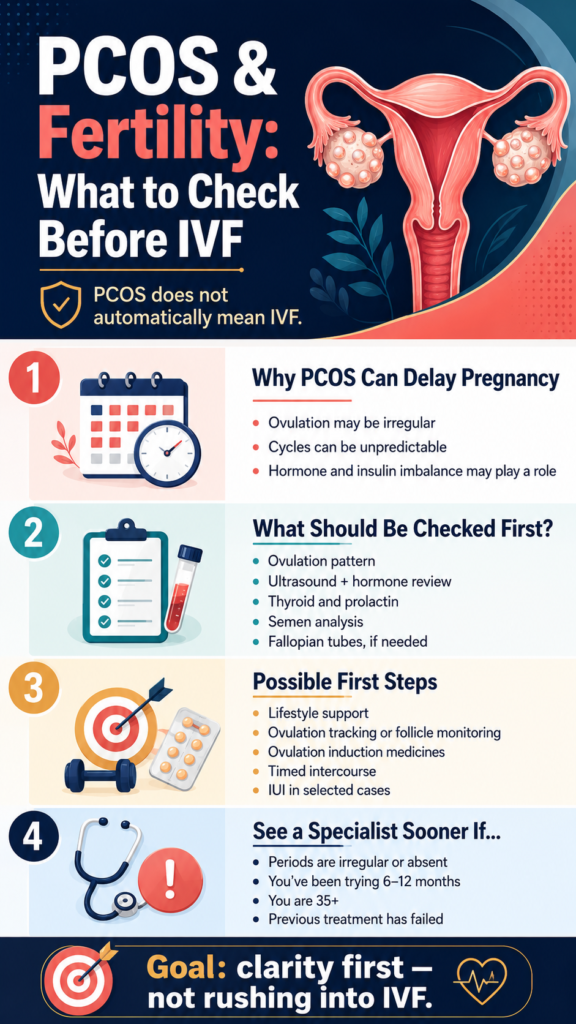
A woman with PCOS who is young, has open tubes, has a partner with a normal semen report and has been trying for a shorter period may be considered for simpler steps first. These may include lifestyle changes, ovulation induction medicines, follicle monitoring and timed intercourse. In some cases, IUI may be considered.
On the other hand, IVF may be discussed earlier if there are additional factors: blocked tubes, severe male factor infertility, advanced age, very long duration of infertility, repeated failed ovulation cycles or other medical concerns.
The decision should come after evaluation, not before.
What we need however – if we start simple treatments like OI or ovulation induction – is PATIENCE. This is a natural journey so monthly fecundability is 20-25% – so you may conceive hopefully in Cycle 1 if you’re lucky, but it may take 3-4 months as well. So IVF is a shortcut with 70-75% for those not having the patience to wait but simpler treatments can work easily for the majority (if they have the patience).
The tests that often matter before deciding treatment
A PCOS fertility review is like assembling a small investigation team. Each test answers a different question.
Cycle history tells the doctor whether ovulation is likely happening regularly.
Ultrasound can show ovarian appearance, follicle growth and any uterine findings.
Hormone tests may include thyroid, prolactin and other reproductive hormones, depending on the case.
Metabolic tests may be useful because PCOS is associated with insulin resistance, type 2 diabetes risk and obesity, according to WHO.
Semen analysis is essential because infertility is not only a female issue. WHO notes that infertility can occur due to male, female or unexplained factors, and male infertility may involve sperm count, motility, morphology or ejaculation issues.
Tubal testing may be considered if pregnancy has not happened despite ovulation, or if there is a history of pelvic infection, endometriosis, surgery or other risk factors.
This is why a good consultation does not jump from “PCOS” to “IVF.” It asks, patiently: What exactly is preventing pregnancy in this couple?
Weight matters, but blame does not help
Many women with PCOS have been wounded by careless weight advice.
“Just lose weight.”
As if she has not tried. As if the body is a light switch. As if weight is a moral exam.
Lifestyle does matter in PCOS. WHO says healthy eating and physical activity are important for women with PCOS, even when they do not lead to weight loss.
That is a more humane way to say it.
The goal is not shame. The goal is better hormonal and metabolic health.
For some women, even modest, sustainable improvements in food, movement, sleep and insulin control may help cycles become more regular. For others, lifestyle alone may not restore ovulation. Both realities exist.
A woman should not be blamed for needing medical help.
When should a woman with PCOS seek fertility help?
A couple should consider seeing a fertility specialist if they have been unable to conceive after 12 months of regular unprotected intercourse, or after 6 months if the woman is 35 or older. ASRM’s ReproductiveFacts guidance gives the same broad timeline.
But PCOS can be a reason to seek help earlier, especially if periods are irregular or absent. ASRM notes that not having regular menstrual periods may be a sign of not ovulating and may be a reason to see a fertility specialist within the first year of trying.
You do not need to wait in confusion for a year if your cycle comes only once in two or three months. You do not need to keep buying ovulation kits that give unclear results. You do not need to begin IVF out of fear either.
You need clarity.
What a PCOS fertility consultation should help you answer
A good consultation should answer these practical questions:
Are you ovulating?
How often?
Is your partner’s semen report normal?
Are your tubes likely open?
Is your thyroid or prolactin affecting cycles?
Is insulin resistance playing a role?
Is timed intercourse enough, or is ovulation induction needed?
Is IUI reasonable?
Is IVF needed now, or can it wait?
Those answers can turn the conversation from panic into planning.
A softer next step
For women in Delhi NCR who have PCOS and are trying to conceive, a PCOS fertility review at Zeeva Fertility can help separate fear from fact.
The aim is not to tell every woman she needs IVF.
The aim is to understand her cycle, ovulation, hormones, ultrasound, partner’s semen report and fertility timeline, then decide what step makes sense.
Because PCOS may be part of your story.
But it does not get to write the ending alone.
FAQs
Can I get pregnant naturally with PCOS?
Yes, many women with PCOS can conceive, especially if ovulation happens or can be restored. The chance depends on age, ovulation, sperm, tubes and other factors.
Does PCOS always mean IVF?
No. PCOS may be managed with lifestyle changes, ovulation medicines, monitoring, IUI or IVF depending on the full fertility picture.
Should my husband do a semen analysis if I have PCOS?
Yes. PCOS in the woman does not rule out male factor infertility. A semen analysis helps avoid incomplete treatment planning.
Are irregular periods a sign of infertility?
Irregular periods may suggest irregular ovulation, which can make conception harder. They should be evaluated if you are trying to conceive.
When should I see a fertility specialist for PCOS?
Consider help if cycles are irregular, you have been trying without success, you are 35 or older, or you have already taken ovulation medicines without pregnancy.

0 Comments
Join the conversation